The Foundational Learning Skills Module: Leveraging child-centric surveys to measure learning outcomes

Why measuring learning matters
Over the past decades, access to education has expanded globally. Yet many children who are enrolled in school are still not acquiring basic literacy and numeracy skills. Large disparities persist, and being in school does not always translate into meaningful learning.
This challenge is especially critical in the early years of a child’s life. Foundational reading and numeracy skills are essential building blocks for future learning and long-term educational success. Without these skills, children risk falling behind early and remaining excluded from learning opportunities later on. However, while data on school attendance are widely available, comparable data on learning outcomes remain limited, particularly across countries and over time. Demand is growing for data that reflect the quality of education and children’s actual learning experiences.
Addressing the data gap on learning
To respond to this gap, UNICEF developed the Foundational Learning Skills Module, a standardized data collection tool designed to measure basic literacy and numeracy skills. The module is implemented as part of the child-centric Multiple Indicator Cluster Survey (MICS) programme, which is the largest source of statistically sound and internationally comparable data on children and women. MICS generates approximately 200 indicators per survey, including 40 SDG indicators and does so in a highly cost-efficient manner by leveraging a single, integrated household survey tool.
In the household context, the Foundational Learning Skills Module directly assesses whether children have acquired essential reading and mathematics skills at the early primary level. It focuses on children aged 7 to 14 and captures learning outcomes at grades 2 and 3.
The module leverages existing MICS infrastructure, including trained interviewers, representative samples, and proven data protocols. It assesses reading proficiency through oral accuracy and comprehension tasks, and numeracy proficiency through number identification, discrimination, addition, and pattern recognition. Notably, in the sixth round of MICS, the FLS module has reached 46 countries and territories, assessing approximately 230,000 children across more than 10 languages.
What the Foundational Learning Skills Module measures
The Foundational Learning Skills Module addresses this need by directly assessing foundational literacy and numeracy skills that children are expected to acquire in the early years of primary education.
Foundational reading skills
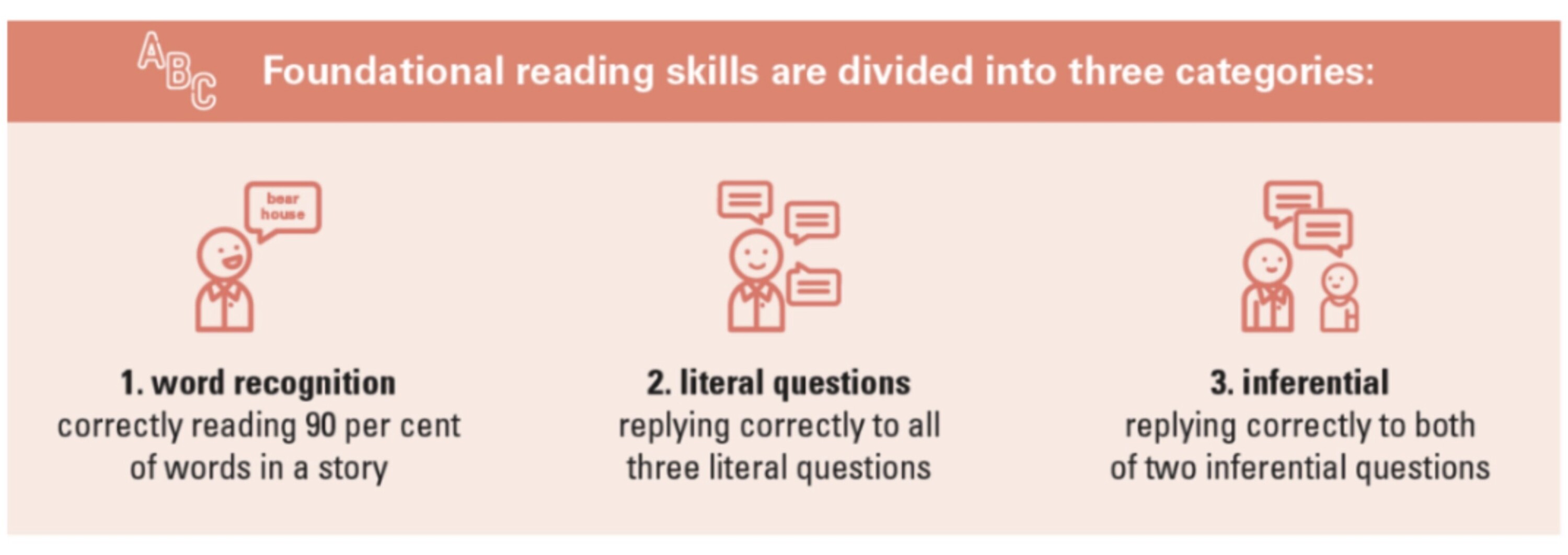
Reading skills are assessed through a sequence of tasks that capture both accuracy and understanding:
- Oral Reading Accuracy
The child reads a short story aloud while the interviewer records words that are missed or read incorrectly. - Literal Comprehension
The child answers three questions based on information explicitly stated in the text. - Inferential Comprehension
The child answers two questions that require drawing meaning from information that is implied rather than directly stated.
Together, these components provide insight into whether children can not only read words, but also understand what they read.
Foundational numeracy skills
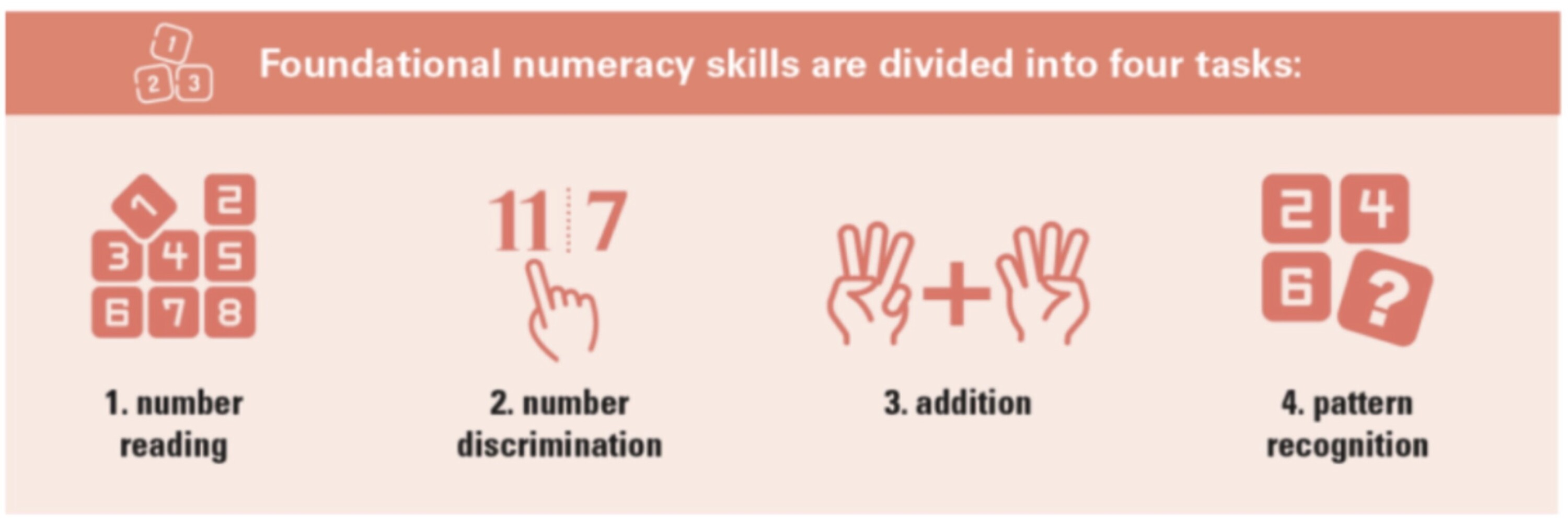
Numeracy skills are assessed through tasks that reflect essential mathematical concepts introduced in the early grades:
- Number Identification
The child identifies numbers ranging from single-digit to three-digit values. - Quantitative Comparison
The child compares pairs of numbers and identifies which is larger. - Addition
The child solves a set of basic addition problems, including both single-digit and one two-digit calculation. - Pattern Recognition
The child identifies missing numbers in numerical sequences or patterns.
These tasks assess whether children have developed the basic number sense and problem-solving skills that underpin more advanced mathematics.
Explore the Foundational Learning Skills Module further through the following lenses:
Timeline of development
Trace the development, testing, validation, and ongoing evolution of the Foundational Learning module within MICS, alongside global efforts to establish standards for measuring learning.

Where has the Foundational Learning Skills (FLS) Module been administered?
See where children’s foundational reading and numeracy skills are being measured through MICS, extending global evidence by measuring early, measuring well, and measuring comparably.

Understanding the learning divide
Examine patterns in foundational reading acquisition across grades, showing where early learning gaps persist and how disparities by household wealth shape outcomes.
Where are children learning? Subnational data on foundational reading and numeracy
A national average can tell us how children are doing overall, but it can also hide large differences in learning within a country. Using data from the Foundational Learning Skills (FLS) module in UNICEF’s Multiple Indicator Cluster Surveys (MICS), the sub-national foundational reading and numeracy skills dashboard helps unpack the picture beyond the national estimates.