This is the first in a two-part series on measuring learning through household surveys. In this blog, we explore what household-based learning assessments are, how they work and why they matter for every child. The second blog takes a closer look at two key tools shaping the field.
Picture a teacher in rural Nepal. She knows exactly which students in her class are struggling with reading; she sees it every day. But what she can’t easily tell you is whether the children who dropped out last year can read at all, or if her current students are falling behind because they are hungry, lack support at home, or are learning in a language they do not speak.
Finding answers to these questions means looking beyond school walls: into communities and households.
What are household surveys and how do they work?
Household surveys have long been a cornerstone of national and global data systems. For decades, governments and international organizations have used them to understand how people live, tracking everything from child health and nutrition to income, employment, and access to services.
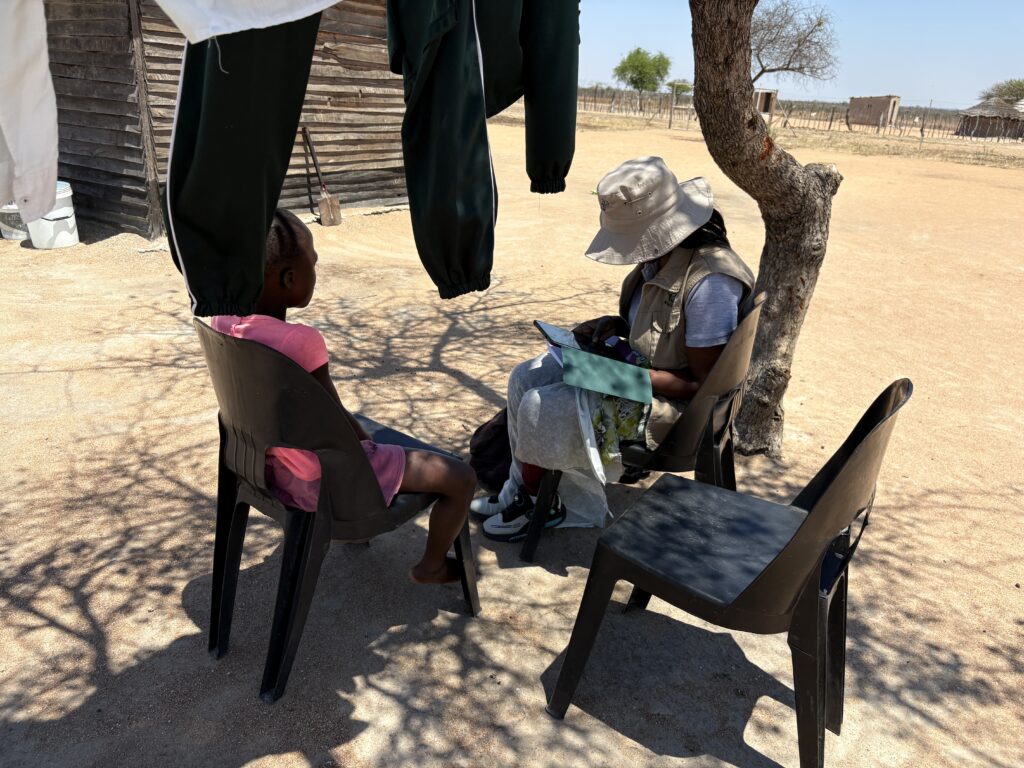
At their core, household surveys collect information directly from people in their homes, using carefully designed samples to ensure that the results represent the wider population. Large programmes such as UNICEF’s Multiple Indicator Cluster Surveys (MICS) are built on this principle, producing nationally representative data that can inform policy and monitor progress over time.
Historically, education data within these surveys focused on access, i.e. whether children were enrolled in school or how many years of education they completed. But over time, household surveys have also been leveraged to answer a more fundamental question: are children actually learning?
The game-changing shift: From counting students to measuring learning
Efforts to measure learning directly in households emerged in response to a major gap in our understanding. While we could count how many children were in classrooms, we did not know whether they were learning to read or do basic math. Citizen-led assessments grew from this gap, but also from a practical reality: measuring learning through schools would have required permissions, partnerships and political buy-in that were not always available. In that context, the household route offered a different path. It allowed civil society organizations to generate independent, population-based evidence on children’s learning without relying on school systems to open their doors or prioritize such measurement.
In India, the Annual Status of Education Report (ASER), led by Pratham in 2005, pioneered this approach through simple, one-on-one oral assessments conducted in households, grounding the exercise in communities rather than institutions. The model quickly spread to countries such as Pakistan, Kenya, Uganda, Tanzania, Mexico and Mali through the UWEZO and PAL Network, making it possible to produce nationally comparable evidence on foundational reading and numeracy at scale. These citizen-led assessments helped shift the conversation from schooling to learning by showing, often for the first time in a clear and public way, that many children were not acquiring foundational skills even while enrolled in school.
This approach did not solve every measurement challenge, but it demonstrated something critical: learning could be measured directly, credibly and at scale outside the boundaries of the formal school system. At the same time, global monitoring systems were evolving. UNICEF’s MICS, originally created in the mid-1990s to track progress toward the World Summit for Children, expanded its topics and methods, in line with emerging global priorities, first for the Millennium Development Goals and later the Sustainable Development Goals, introducing the Foundational Learning Skills (FLS) module in 2016 to directly assess foundational reading and numeracy at scale.
Together, these developments marked a shift from measuring schooling to measuring learning.
Why measure learning through household surveys?
Household surveys add an important dimension to how learning is measured. They do not replace school-based assessments but complement them by expanding both who is included and what can be understood about children’s learning. School-based assessments remain essential for understanding how education systems are performing and what children are learning within classrooms. Household surveys build on this by drawing their sample from the full population of households rather than from schools. This allows them to include a broader cross-section of children, including those who may not be consistently present in school. While they do not capture every child, they reduce a key source of bias that comes from relying only on school-based samples.
Household surveys also make it possible to connect learning outcomes with the conditions in which children live. Because they collect information on health, nutrition, caregiving, and household resources, they allow for a more holistic understanding of the factors associated with whether a child is learning. This combination changes the kinds of questions that can be asked. Alongside insights into how education systems are performing, it becomes possible to explore why some children are learning and others are not, and how these differences relate to circumstances both inside and outside the classroom. For example, a recent analysis by UNICEF shows the persistent gap between children belonging to the wealthiest and poorest households in acquiring foundational skills.
Household learning assessments also bring learning outcomes to the parents and caretaker’s spheres. In many parts of the world, parents assumed that sending their children to school was equal to making them readers. By allowing parents to witness what their children could read and how they could manipulate numbers brought to the family sphere the distinction between schooling and learning.
There is also a practical advantage. Integrating a learning module into an existing household survey allows countries to generate nationally comparable data without building a separate assessment system from scratch, making it a scalable and cost-effective approach. Together, school-based assessments and household surveys provide a more complete picture of learning, one that reflects both how systems function and how children experience learning in their everyday lives.
Why does this matter now?
The world has committed to ensuring that every child achieves foundational literacy and numeracy by 2030. But progress toward that goal depends on knowing who is learning and who is not. For too long, the children who are most at risk of being left behind have also been the least visible in our data. Household surveys are helping to change that by going where children are and capturing what they actually know. The tools to do this already exist, and they continue to improve. What matters now is whether the evidence they generate is used to inform policy and drive action.
In the next blog, we take a closer look at how they work, how they differ, and what we can learn by bringing their insights together.