Introduction
Across the globe, governments are striving to improve education outcomes and reduce inequalities. But to make smarter, evidence-based decisions, they need more than just data from schools – to truly understand a child’s educational experience, governments need to understand what happens in the classroom and what happens at home.
That is the vision behind UNICEF’s MICS-Link in Education Initiative – connecting data from household surveys and school administrative records to provide a fuller, more nuanced picture of children’s education experiences. Piloted in Fiji, Eswatini and Vanuatu, the initiative is now expanding to new countries, expanding methodological development and unlocking fresh potential for education planning and policy.
What is MICS-Link?
MICS Link is an initiative designed to promote the integration of household survey data from the Multiple Indicators Cluster Survey (MICS) programme with data from other sources, including administrative systems, censuses and other surveys. MICS is UNICEF’s flagship household survey program, supporting nationally led, child- and women-centric data systems in over 120 countries.
In education specifically, MICS-Link connects household data from MICS with school-level data from Education Management Information Systems (EMIS). While household data reveals details about children’s home environments, such as access to books, parental support and basic resources, school data from EMIS provides essential details about school enrollment, resources, teachers and school facilities. By integrating these two types of data, MICS-Link allows for more comprehensive analysis of education participation, equity and outcomes –helping education stakeholders move beyond isolated datasets and toward integrated evidence for decision-making.
Why link household and school data?
By combining these two perspectives, MICS-Link enables countries to explore critical policy questions: Are disadvantaged children attending lower-resourced schools? How do home learning environments influence school attendance and outcomes? What gaps or inequities are masked when using just one data source? How can new analytical techniques—like geo-spatial analysis or small area estimation—be applied to linked datasets?
This approach helps push boundaries with the aim of understanding if linking the two data systems has the potential to uncover the factors shaping learning outcomes and provides the evidence needed to evaluate and improve education systems.
Leveraging funding from the Global Partnership for Education (GPE) to support MICS-Link in education
The Global Partnership for Education Knowledge and Innovation Exchange (KIX) brings together 88 low- and middle-income countries that are partners of the Global Partnership for Education to identify common policy challenges and facilitate knowledge sharing and evidence building. Implementing MICS-Link in countries is achieved in two phases (see figure below), with GPE-KIX funding focusing on/emphasizing the use of the integrated data:
- Phase 1 centers on operationalizing the linkage during MICS design and implementation. This involves assessing the feasibility and scope of integration, adapting MICS tools to capture information necessary to link children to their schools, and reporting basic descriptive statistics and data quality metrics in the Survey Findings Report (SFR).
- Phase 2 begins after the release of the MICS data and centers on deeper, collaborative analysis. This phase includes:
- Geo-coded analysis (where GPS data are available)
- Comparing linked and non-linked schools to assess representativeness
- Working with Ministries of Education and statistical offices to prepare EMIS data for use
- Exploring advanced analytics, including regression models and small area estimations
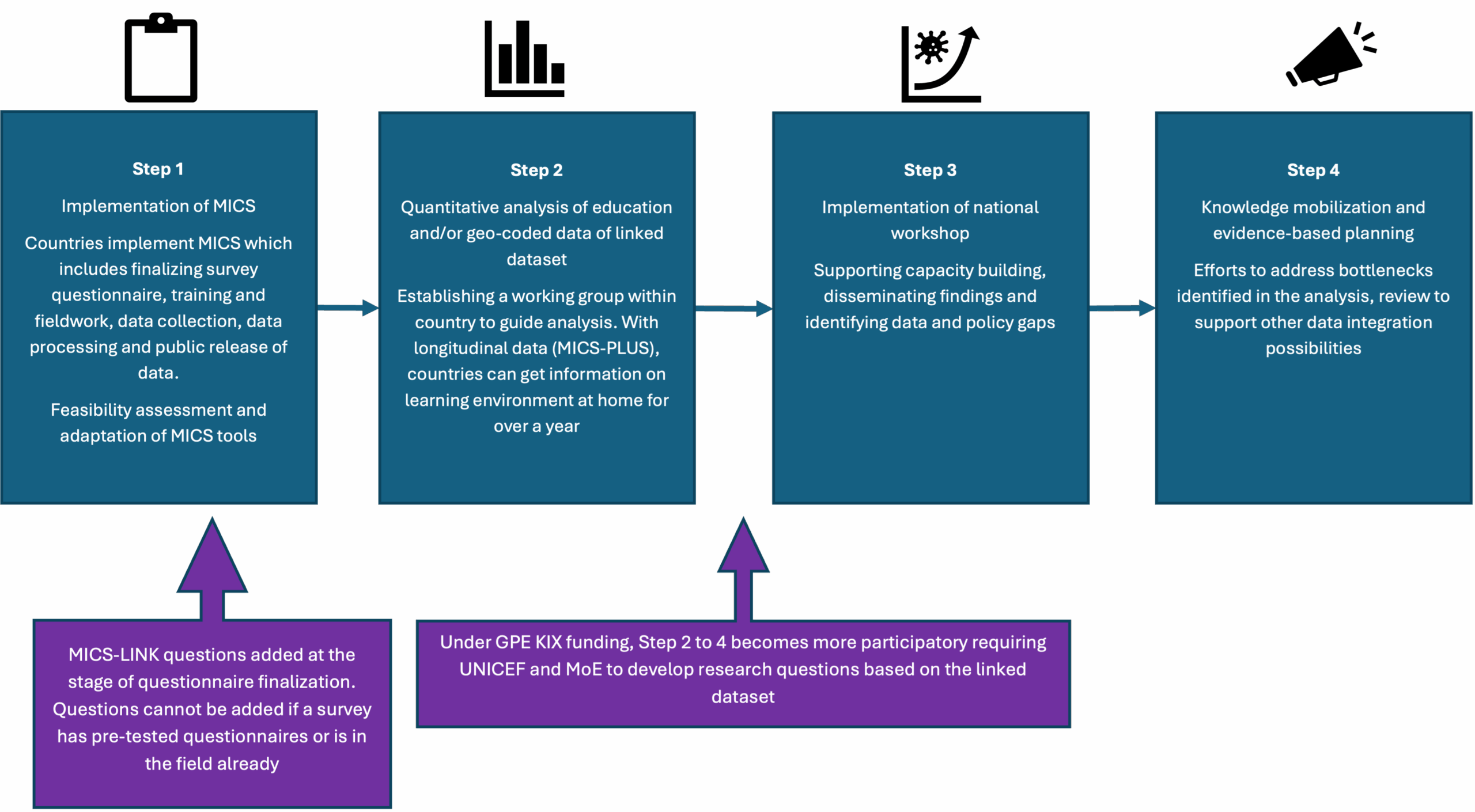
Each country participating in Phase 2 establishes a Technical Working Group (TWG) to co-design the research. These working groups include the Ministry of Education, National Statistical Office, UNICEF country and regional offices and academic partners. The goal in each country is not just analysis, but also local capacity building –enabling national teams to carry forward this work independently.
Why now?
The timing of MICS-Link aligns with growing global momentum for quality education and data-driven policy. The number of topics and indicators relevant for education policy and programming has significantly grown since the launch of the 6th round of MICS in 2016, with new modules on foundational learning, digital access and ICT skills opening up more possibilities for meaningful analysis. EMIS systems, meanwhile, are expanding in scope and improving in quality. MICS-Link sits at the intersection of these two trends, offering a practical pathway for countries to get more value from the data they already collect.
This effort is also aligned with global momentum—particularly the work of the Foundational Learning Coalition, which calls for timely, disaggregated data to support targeted interventions, and the ambitions of the UNICEF Strategic Plan 2026–2029, which places strong emphasis on supporting national governments to scale results for every child through evidence-informed systems strengthening.
Looking ahead
With pilots completed in Fiji, Eswatini and Vanuatu, and new work underway in Nepal, Madagascar, Belize and Guatemala, the MICS-Link in Education Initiative is steadily gaining momentum. The initiative is helping to advance methodological thinking on how to integrate survey and administrative data in practical, context-specific ways, while also opening new avenues for analysis that were previously out of reach.
The work is revealing both the promise and the complexity of linking complementary –but often structurally different –data systems. It is broadening what countries imagine as possible, while also highlighting real-world constraints that shape what can actually be done. These insights are helping teams reflect on the quality, completeness, and interoperability of their data systems.
More importantly, MICS-Link is beginning to spark deeper engagement between education and statistical sectors –encouraging countries to explore how household survey data might inform the design of administrative systems, and vice versa. As technical working groups experiment with new types of analysis, they are building the foundations for more integrated data use in the future. This blog is first in a series of posts that will explore deeper the work being undertaken as part of MICS-Link with EMIS.