
Are the most disadvantaged children concentrated in the most under-resourced schools? Do long journeys to school push children out of school altogether? And how do home and school environments jointly affect educational outcomes? Questions like these are hard to answer because the evidence sits in two places. What happens in a child’s home – their family’s circumstances, and whether they are learning – is captured by household surveys. What happens in their school – its facilities, staffing, and size – is recorded separately by education ministries. MICS-EMIS analysis brings these two together. It integrates data from the Multiple Indicator Cluster Survey (MICS), UNICEF’s flagship household survey programme, with administrative education data from Education Management Information Systems (EMIS). This work is an application of MICS-Link, a broader initiative supporting links between MICS household survey data and administrative data sources. With dedicated support from the Global Partnership for Education Knowledge and Innovation Exchange (GPE-KIX), MICS-EMIS analysis is being implemented in eight GPE partner countries to build a combined picture of children’s home and school environments.
This post builds on our earlier introduction to the MICS-Link in education initiative and focuses on the technical process behind linking MICS household survey data with EMIS administrative school data.
From MICS to a linkable student dataset
Under MICS-Link, the survey carries additional questions to identify the specific school each child attends. That data makes linkage possible. Because MICS microdata are publicly released in anonymised form, these identifying variables (such as school name) are not included in the public dataset.
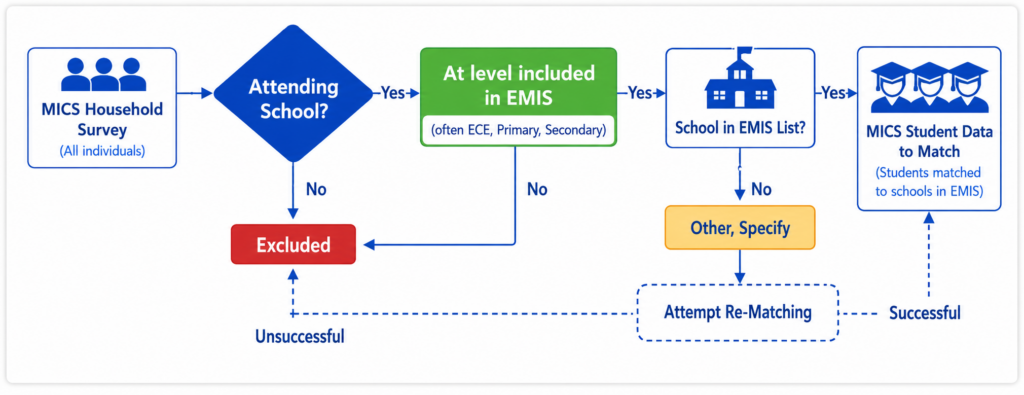
The full MICS dataset is useful for district-level comparisons, but linking children to school characteristics is only possible when the reported school can be clearly identified and matched to EMIS. Starting from the full MICS dataset, the process retains only students whose school can be matched to EMIS and documents how many cases remain linkable (Figure 1). This filtering step is about ensuring reliable linkage, not restricting broader use of MICS.
Figure 1: Creating a student subset from the MICS dataset
Preparing EMIS data for linkage
Ministries of Education usually hold EMIS data, which typically include (1) school-level records covering facilities, enrolment and teacher counts as well as (2) individual-level records for students and teachers. The aim is to distil these into a single comprehensive school-level dataset that can be merged with MICS.
A Technical Working Group comprising the Ministry of Education, National Statistical Office and UNICEF guides this work, reviewing the EMIS questionnaire and selecting priority variables. Preparing the data then follows three main steps:
Clean and transform
First, this step involves checking EMIS data for missing values, outliers and unexpected entries, and transforming them into analysis-ready indicators. A drinking water source, for example, can be recoded into an improved/unimproved indicator, and open text fields can be grouped into consistent categories (such as ethnicity).
Aggregate individual records to the school level
Second, where EMIS contains individual records, these are summarised into school-level indicators, because the linkage attaches MICS children to schools (not to individual EMIS records). Teacher data, for instance, can produce school indicators such as total teachers, share with teaching qualifications, or teachers by sex. Student records can similarly be summarised into indicators such as enrolment by sex or ethnicity, or average test scores.
Run consistency checks
Third, a few basic consistency checks can greatly improve data quality – for example, comparing a school’s reported enrolment totals with the summed number of student records where both exist. Flagging potential discrepancies like this can also help strengthen EMIS systems.
Together, these steps turn raw EMIS variables into a clean school-level dataset ready to be linked.
Creating the match
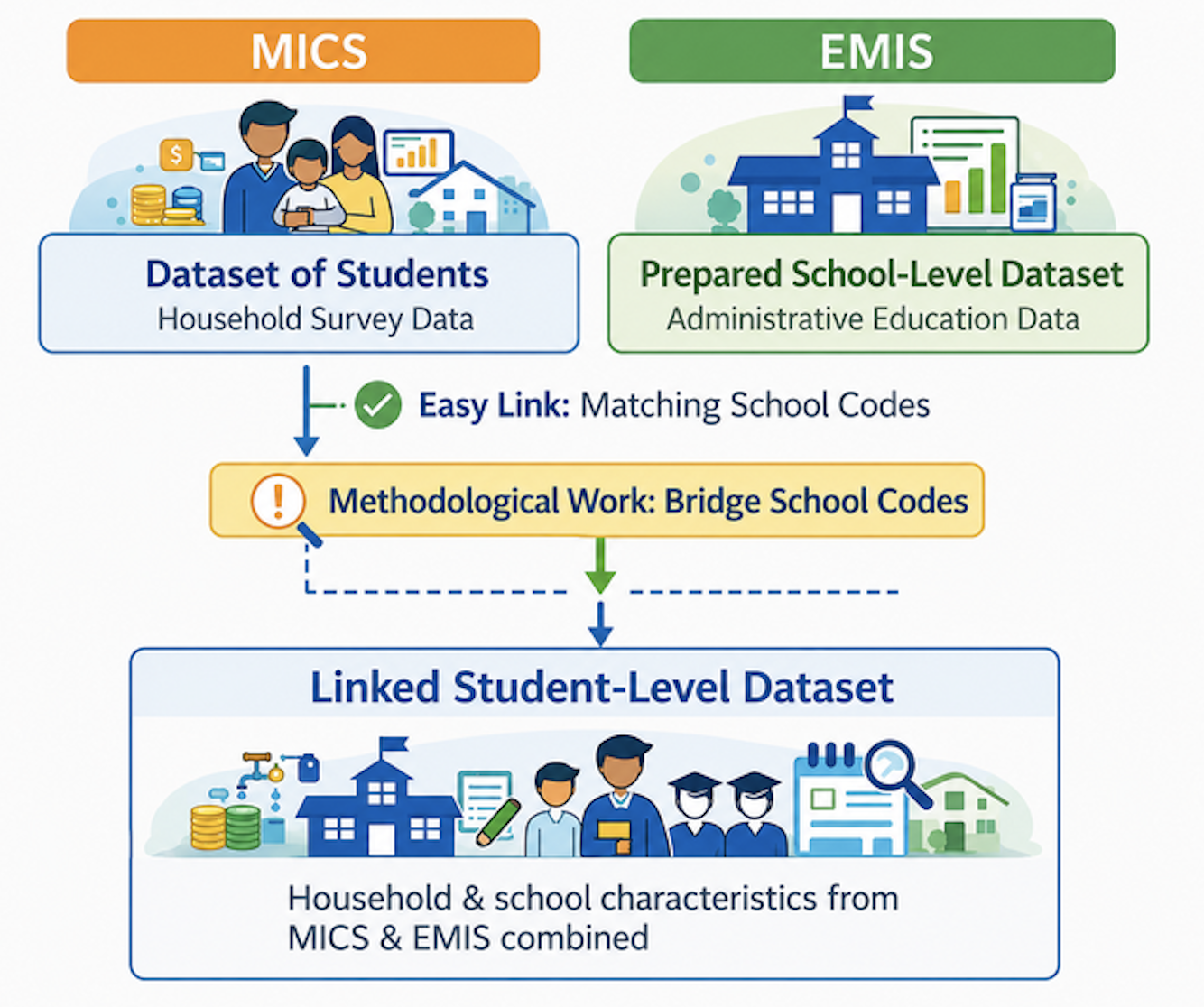
With both pieces in place – the linkable MICS student dataset and the cleaned EMIS school dataset – the two can be merged using the school identifier collected in MICS.
The resulting dataset combines household information (e.g., socio-economic conditions and learning outcomes) with school characteristics (e.g., infrastructure, staffing, size). This enables analysis of how home and school environments jointly shape education outcomes.
Beyond individual students: education indicators
The value of MICS-EMIS analysis extends beyond individual student linkage. By comparing indicators from the two data sources, MICS-EMIS analysis reveals whether both sources are telling a consistent story. For example, district-level education indicators measured through MICS, such as out-of-school rates or completion rates, can be examined alongside EMIS measures. These comparisons can help identify patterns across the two systems and provide useful checks on how household survey indicators relate to characteristics of the school system within districts.
Figure 2: Matching MICS and EMIS data
What’s next for MICS-EMIS?
Countries including Belize, Guatemala, Madagascar, Nepal, Ukraine and Samoa have already implemented the linking questions in their MICS surveys and are in the final stages of data collection or preparing for data release. These countries are now establishing Technical Working Groups to co-create the analysis with a focus on knowledge transfer and local capacity building.
By connecting household and administrative education data, MICS-EMIS provides a powerful tool for understanding how home and school environments shape education outcomes and for informing more equitable education policies.


