MICS-EMIS Analysis
Connecting household and school data for better education insights

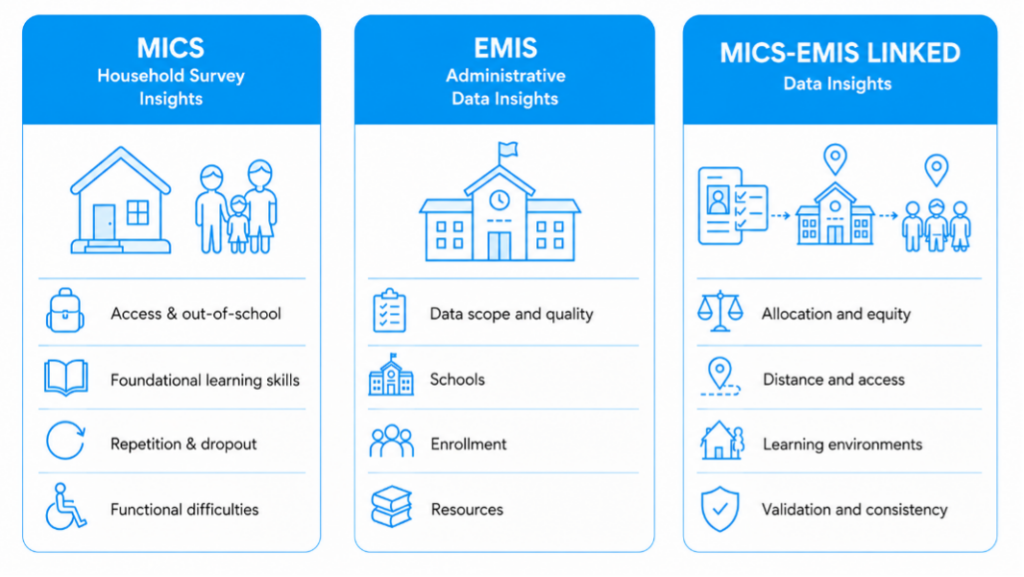
Every country collects data on its children and its schools, but too rarely do these two sources speak to each other. On one side are household surveys, where families share what’s happening with their children – whether they’re in school, if they’re learning and the barriers they face. On the other are school records, where Ministries of Education track what’s happening inside the schools – their resources, their teachers and which students they serve. MICS-EMIS Analysis brings the two together: working hand in hand with Ministries of Education and National Statistical Offices, it links a country’s school records – called Education Management Information Systems (EMIS) data – with data from UNICEF’s flagship household survey, the Multiple Indicator Cluster Survey (MICS). This builds on UNICEF’s MICS-Link initiative, which makes the connection possible by noting which school each surveyed child attends.
The result is a single, richer source of evidence – one that supports Ministries of Education, National Statistical Offices and UNICEF country and regional teams in generating policy-relevant insights about who is in school, who is being left behind and who is learning. Each source tells part of the story. Together, they reveal the full picture.
How MICS-EMIS Analysis works
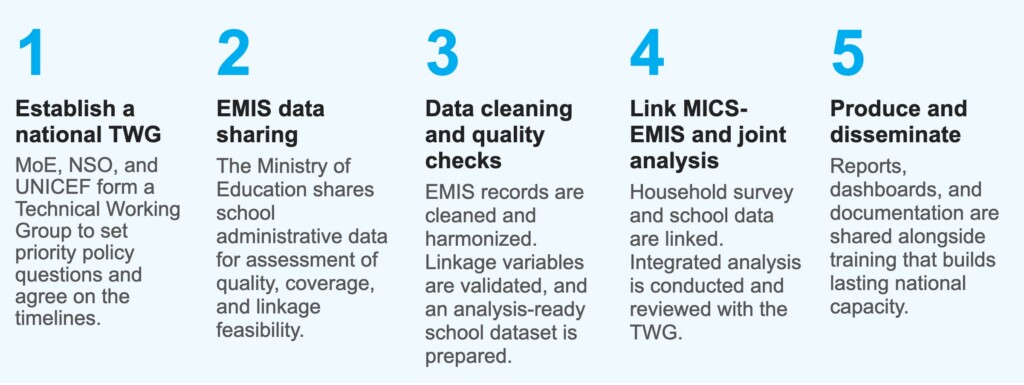
In every country, the work is led locally. A national team, known as a Technical Working Group (TWG), made up of members from the Ministry of Education, National Statistical Office and UNICEF, comes together to define priority questions, oversee data linkage and validate findings. Analysis uses open-source software on collaborative platforms, ensuring that the workflow is transparent and reproducible.
KEY DELIVERABLES IN EACH COUNTRY
- Cleaned and harmonized school data: A cleaned EMIS school-level dataset with standardized variables and data quality flags, alongside documentation and workflow
- Connected household and school data: Linked MICS-EMIS data are integrated into a clean dataset, ready for policy analysis
- Analytical report or policy brief: Addressing priority questions defined by the national TWG
- Interactive dashboards: For ministries and partners to explore and communicate findings
- Technical documentation: Methods, validation steps and lessons learned
- Capacity strengthening: Hands-on collaboration, training and knowledge exchange
Where MICS-EMIS Analysis is being implemented
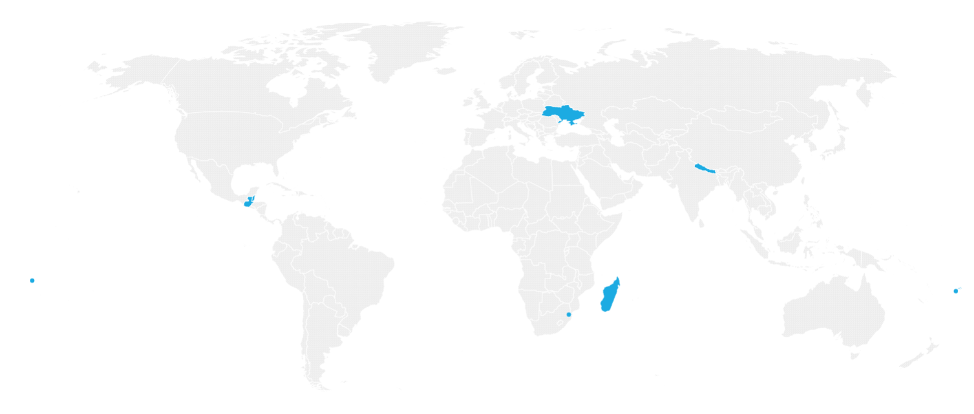
With support from the Global Partnership for Education Knowledge and Innovation Exchange (GPE–KIX), MICS-EMIS Analysis is now at work in eight countries across five regions. It began with pilots in Fiji and Eswatini, and is now underway in Nepal, Madagascar, Ukraine, Belize, Guatemala and Samoa.
Outputs
Country reports, dashboards and methods documentation will be shared here as they become available.
Fiji: Access the Country report and distance-to-school policy brief.
Resources
Initiative brochure
Guidance and tools
- Implementation manual (coming soon)
- Data analysis manual (coming soon)
- TWG package ToR, templates (coming soon)