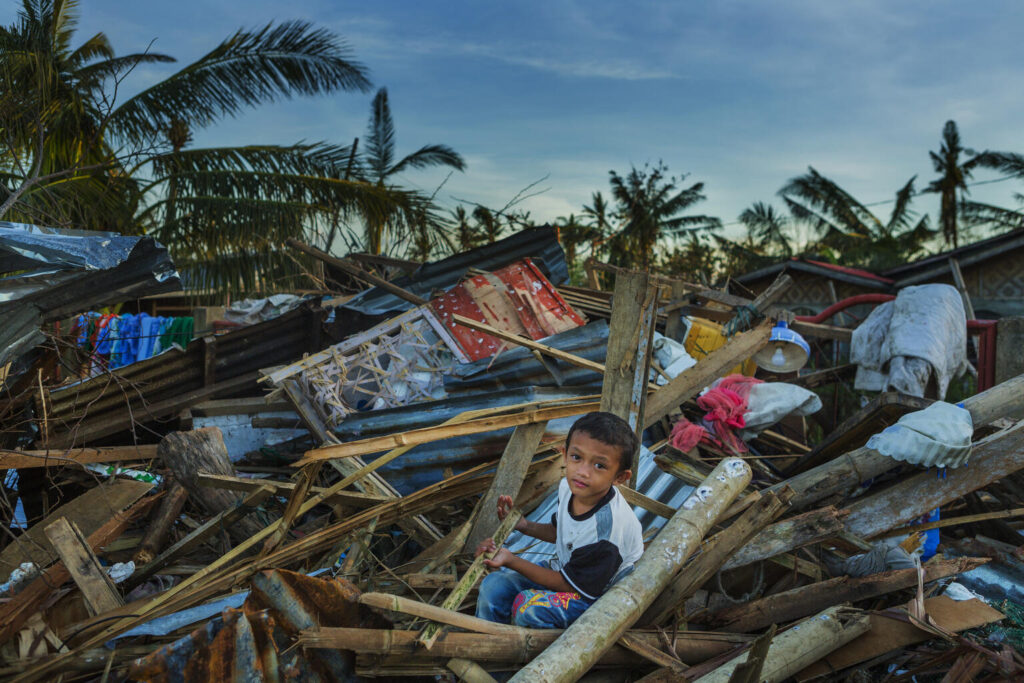
As climate-related disasters grow more frequent and intense, the challenge is no longer just about responding; it’s about acting early to protect the most vulnerable, especially children, before hazards reach their peak.
Humanitarian action today is often seen as a reactive endeavour. After all, despite broad efforts to plan for disasters, most resources are mobilized only after damage occurs. Emerging technologies offer new opportunities to mount more proactive responses. “We can prevent children from being unaccounted for weeks after a hurricane hits. We can move towards new models that mitigate the impact of predictable hazards,” observes Fernando Jambrina, Monitoring & Evaluation Specialist, UNICEF Nicaragua Country Office.
UNICEF recently launched the Ahead of the Storm initiative through the Frontier Data Network (FDN) to explore how predictive analytics can trigger earlier, more proactive humanitarian action in collaboration with country, regional and HQ teams, as well as academic and private sector partners. This isn’t about predicting the weather. It’s about predicting what the weather will do to children.
How could we act earlier?
Humanitarian teams now have access to more early warning systems and hazard forecasts than ever before. However, turning alerts into specific, localized anticipatory action remains a challenge.
UNICEF’s Latin American and the Caribbean Regional Office (LACRO), in collaboration with the FDN, has increasingly been embracing innovative data approaches. As Liliana Carvajal, Data and Monitoring Manager at LACRO, emphasizes, “Grounding frontier data initiatives in real country challenges, rather than pursuing innovation for its own sake, is key to the success of these initiatives”. To this end, the regional office hosted a field assessment mission along with the FDN team to do exactly that: capture stakeholder perspectives and identify critical data gaps directly from those working on the ground.
Consultations across UNICEF’s programme areas, including health, nutrition, water, sanitation, and hygiene (WASH), emergency response and logistics, revealed that while teams may know a hurricane is approaching, they often lack the operational insights to act proactively.
“When planning for a humanitarian action, we face critical questions that are usually unanswered for weeks,” Mjrko Rennola, Regional Emergency Specialist, explains. “Which schools are likely to be damaged and how many students will be impacted? Which health centers could flood? Which communities may suffer the interruption of safe water services? Knowing a storm is coming isn’t enough. We need to know what it will do and where, and to act, with no regret.”
At the same time, traditional funding mechanisms release money only after disasters, not in anticipation of them. Even with sound preparedness planning and humanitarian scenario construction, humanitarian funding often requires detailed damage and needs assessments that usually arrive weeks after impact, when the opportunity for impact mitigation has already passed.
What’s missing is not the data about what is coming, but insight into what it will do and who it will affect, real-time. This is the crucial link that today’s systems fail to provide.
From weather warnings to impact-based forecasting
To help address this challenge, UNICEF’s FDN hosted two MIT Sloan Master of Business Analytics students, Caio de Prospero Iglesias and Sidharth Vijay, to develop a prototype for anticipating forecasted hurricane impact. Their “capstone project” explored how predictive analytics could close this gap, moving from general risk awareness to impact-based forecasting.
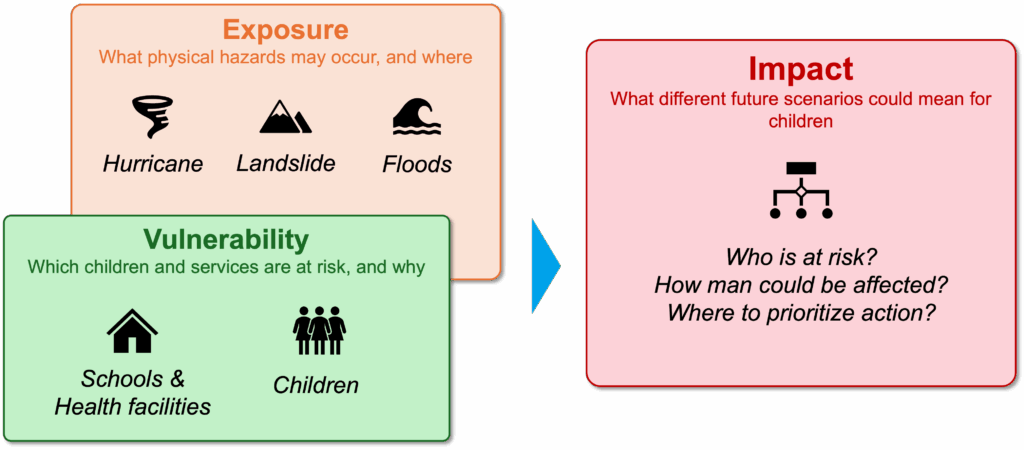
Based on stakeholder priorities, the students developed a prototype framework connecting real-time hazard forecasts with data on child vulnerability and infrastructure. It integrates:
- Meteorological and hydrological inputs (hurricane tracks, rainfall intensity, river discharge and landslide risk)
- Maps of schools, health and WASH facilities
- Vulnerability indicators such as child population density and poverty levels
Caio de Prospero Iglesias, MIT Sloan Master of Business Analytics ’25, reflects: “This isn’t about making business processes more efficient. It’s about exploring whether we can use data to save lives. The framework is experimental, but it shows what might be possible if we can connect the dots between weather forecasts and vulnerable children.”
As new hazard forecasts are released almost in real-time, the model recalculates which areas, services, and populations are most likely to be affected. The results are dynamic impact predictions that could help humanitarian actors move from reactive response to proactive decision-making.
In practice, this could transform field operations. For example, AI-enhanced forecasts could predict that a hurricane will likely result in flooding of three rural health clinics in Nicaragua within 48 hours. Field teams could evacuate medical supplies and relocate mobile health services before roads become impassable. Children requiring routine immunisations could be reached proactively, rather than waiting weeks for post-disaster access to resume. These aren’t hypothetical gains. They mark the difference between prevention and emergency response.
Sidharth Vijay, MIT Sloan Master of Business Analytics ’25, adds: “The real challenge was bridging meteorological forecasting with what humanitarian teams actually need to know. The prototype demonstrates that it’s technically feasible to translate hazard data into location-specific impact predictions.”
Rather than replacing existing systems, the prototype enhances them by adding a layer of analytical foresight, enabling:
- Strategic pre-positioning of supplies based on forecasted disruption
- Risk-informed funding proposals ahead of impact
- Targeted response planning in areas where children face the highest risk
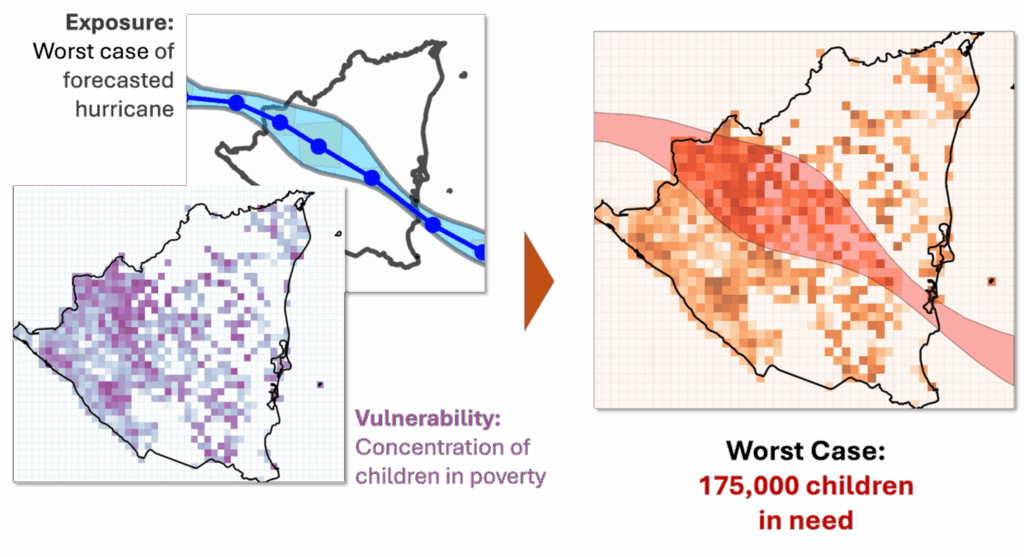
Technically, the model draws on global forecasting systems from sources including Google DeepMind’s AI-powered hurricane prediction models, NASA’s artificial intelligence-enhanced landslide monitoring and international flood monitoring services. While the current prototype uses traditional analytical methods, future versions could leverage AI and machine learning to refine impact predictions and automate risk assessments in real-time.
Exploratory yet promising, the prototype adds to the Ahead of the Storm body of work, helping to make early action more precise, timely and focused on those who stand to lose the most.
From pilot to practice: The path forward
The broader Ahead of the Storm initiative is now being piloted in Nicaragua and other Caribbean countries, where national and regional teams have expressed strong interest in using predictive analytics to strengthen preparedness and early response. With frequent hurricanes, floods and landslides, the region faces both urgent need and a powerful case for this approach.
The prototype contributes to this pilot by revealing both the potential and the practical challenges of integrating predictive models into humanitarian operations. But scaling this work requires more technology. It demands institutional alignment, sustained access to reliable forecast data, and a shared commitment to shift from reactive response to forward-looking preparedness.
As Yves Jaques, Chief of the Frontier Data Technology Unit, notes: “Without modern data infrastructure, even the best predictive models remain theoretical. We need robust systems that swiftly discover and ingest real-time forecasts, process vulnerability data at scale, and deliver actionable insights to field teams in time to act.”
The goal is not to replace existing systems, but to enhance them, giving decision-makers a predictive edge when time is critical.
Flexible by design, the initiative can be adapted to different hazards and contexts, depending on local data availability and technical capacity. As more UNICEF offices engage with predictive approaches, Ahead of the Storm offers a foundation for global learning and innovation, reflecting the Frontier Data Network’s core mission: turning data innovation into operational impact through collaboration.
This project also demonstrates the power of science and research in humanitarian work and innovation. Academic engagements bring fresh analytical thinking, cutting-edge methods, and scientific rigor that can transform how humanitarian actors understand and respond to risk. As FDN Principal Researcher Manuel García-Herranz explains: “Strong engagements with leading research centers and academia are essential in both directions: to ensure that our solutions are grounded in solid science and expertise, and that the world’s brightest minds are engaging with child-centric, high-impact problems”.
The MIT Sloan capstone project did more than deliver a prototype; it demonstrated how academic research can be directly applied to operations and humanitarian challenges, creating a model for future scientific engagements across the sector.
This focus on proactive, anticipatory, and early response also creates opportunities for new partnerships between humanitarian agencies and academic institutions, adapting emerging analytical methods to real operational needs. “UNICEF is actively engaging with diverse private and public sector partners to ensure initiatives like Ahead of the Storm can, from the start, build with and learn from global leading experts on data and technology,” says Viviana Canon Tamayo, Frontier Data Network Program Coordinator. “In the case of this initiative, we are grateful to already count on the immense help of MIT-Sloan, the Development Data Partnership (DDP), and the Spanish Agency for International Development Cooperation (AECID).”
In a world of escalating climate disruption, reactive response is not only insufficient—it’s unsustainable. Children cannot afford to wait for systems to catch up. As pilots like Ahead of the Storm advance, they will help uncover what works, what barriers persist and how predictive approaches can be scaled across different contexts.
Acknowledgements
The Frontier Data Network (FDN) at the UNICEF Chief Statistician Office is dedicated to accelerating the adoption of innovative data technologies and practices to enhance the delivery of impactful, reproducible, data-driven solutions for the world’s most vulnerable children. We achieve this by cultivating community and partnerships to scale talent, data infrastructure and new analytics initiatives.
Project team includes the UNICEF’s Frontier Data & Tech Unit (Division of Data, Analytics, Planning and Monitoring), Office of Innovation, Giga, Latin America and the Caribbean Regional Office, Nicaragua Country Office, and MIT, with special thanks to Daniel Alvarez, Viviana Canon Tamayo, Liliana Carvajal Velez, Ivan Javier Dotu Rodriguez, Manuel García-Herranz, Aurelio Samir Henriquez Cruz, Alexandre Jacquillat, Fernando Jambrina, Yves Jaques, Kyriaki Kalimeri, Ilona Milner, Caio de Prospero Iglesias, Mjrko Rennola, Felix Schwebel, and Sidharth Vijay.
The team is grateful to MIT Sloan and the Capstone Project of the Master’s in Business Analytics program. UNICEF served as the host organization for this project, which provided essential data science capacity and expertise to complete this exercise.
This project was made possible in part through the Spanish Agency for International Development Cooperation’s (AECID) generous support of the Frontier Data Network.


