Beyond the full score: A closer look at children’s numeracy skills
Data story · MICS Foundational Learning Skills
Unpacking foundational numeracy
In MICS, a child has foundational numeracy skills only if they answer all 21 numeracy questions correctly. In many countries, only a minority do. But the children who fall short are not all in the same place: some are one or two questions away, while others answer none. Looking at how many questions children answer correctly shows where they stand, and where support could start.
Three questions the data answer
- 1Story 1: Exploring scoresAvailable now
How close are children to a full score?
In Chad, 58% of children scored zero. In Togo, the most common score was 19 out of 21. - 2Story 2: The four sub-domainsComing soon
Where are the gaps in children’s skills?
Pattern recognition is the weakest skill in 47 of 56 surveys. - 3Story 3: The learning gapComing soon
What do we know about the children who fall short?
In 43 of 56 surveys, more than half of children who fall short answer every question correctly in at least one skill.
Country profiles for all 56 surveys, printable as one-page PDFs, are also coming soon.
Story 1 · Exploring scores
How close are children to a full score?
Foundational numeracy skills are among the first building blocks of mathematics, and children are generally expected to learn them in the early grades of primary school. Yet in many countries, only a minority of children aged 7 to 14 answer all 21 MICS numeracy questions correctly, including many who are well past those grades.
Looking at how many questions children answer correctly shows that the children who fall short are not all in the same place. In some countries, a large share are nearly there, missing a full score by only one or two questions. In others, many answer few or no questions correctly. These situations call for different responses: targeted support where children are close, and a focus on the most basic skills where many are just starting out.
Key findings
- Across 55 surveys, children answer between 2.3 and 20.1 of the 21 questions correctly on average.
- In 8 surveys, more than a third of children answer 5 or fewer questions correctly.
- The same share of children at full score can hide very different realities. In Chad 2019 and Togo 2017, fewer than 1 in 10 children answer all 21 questions correctly. But 58% of children in Chad score zero, while in Togo the most common score is 19.
About the data
How MICS measures foundational numeracy
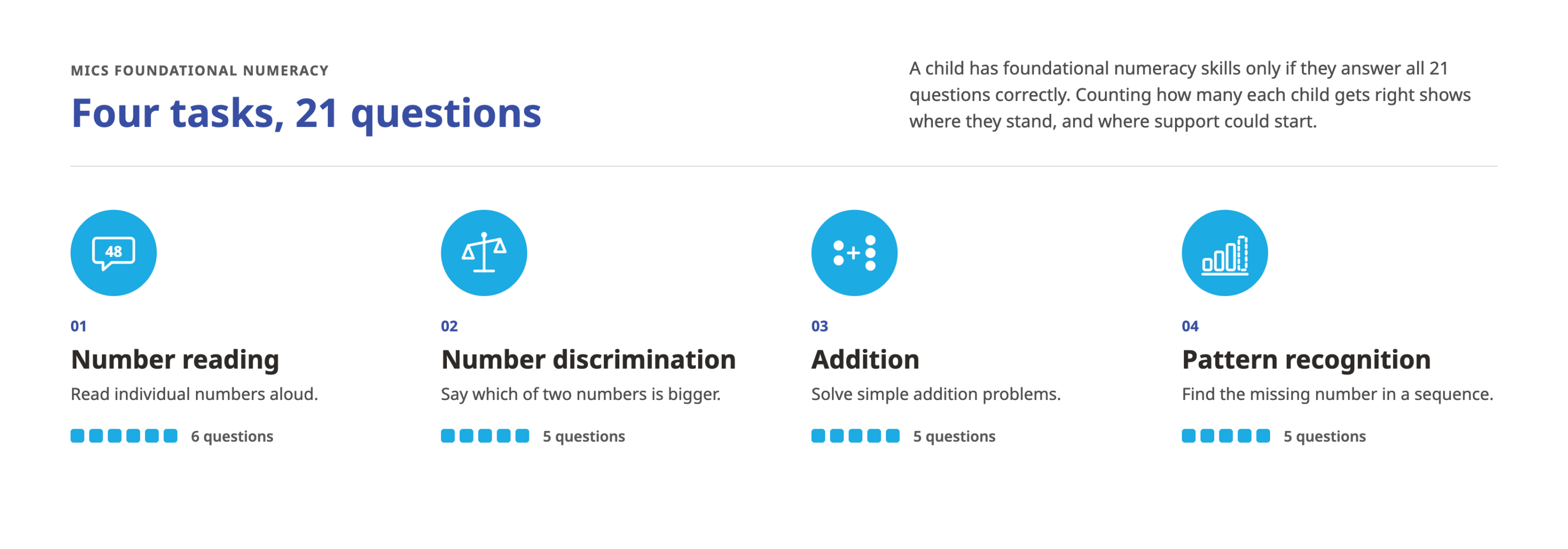
The Foundational Learning Skills module of the Multiple Indicator Cluster Surveys (MICS) tests one randomly selected child aged 7 to 14 in each sampled household, at home and in the language of the child’s choice, whether or not they attend school. The numeracy test has 21 questions across four sub-domains. A child is counted as having foundational numeracy skills only if they answer all 21 correctly.
| Sub-domain | Questions | Example |
|---|---|---|
| Number reading | 6 | What is this number? 731 |
| Number discrimination | 5 | Which is bigger: 65 or 67? |
| Addition | 5 | How much is 13 + 6? |
| Pattern recognition | 5 | 20, ___, 40, 50. What number goes here? |
| Foundational numeracy skills | 21 | All questions correct |
Example questions from the Ghana MICS 2017/18 questionnaire. Countries may adapt the numbers.
About the scores
- Each question is scored 1 if correct and 0 if incorrect, “I don’t know” or no response. A child’s score is the number of questions answered correctly, from 0 to 21.
- Every question counts equally, whatever its difficulty, so a score shows how many questions a child answered correctly, not which ones.
- Figures are weighted, and each belongs to one survey: nothing is pooled across surveys. Estimates based on fewer than 25 children are not shown.
- The analysis covers 56 surveys conducted from 2017 to 2024. Charts that compare scores show 55, as Sierra Leone 2017 used a 19-question test.